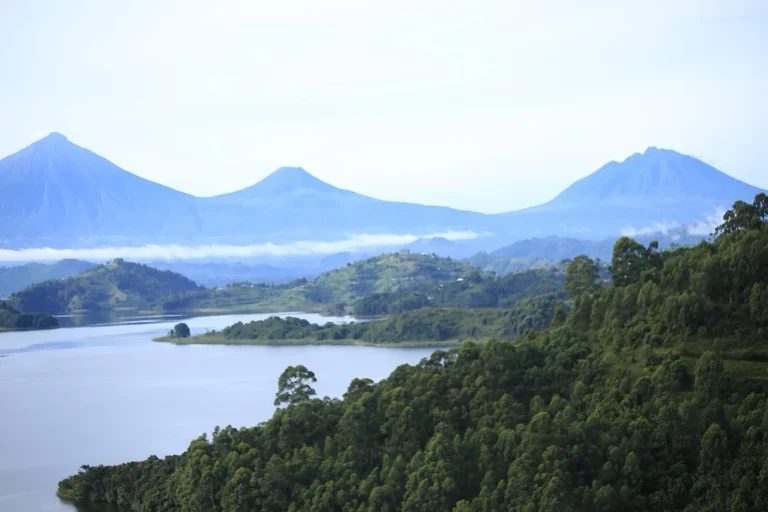
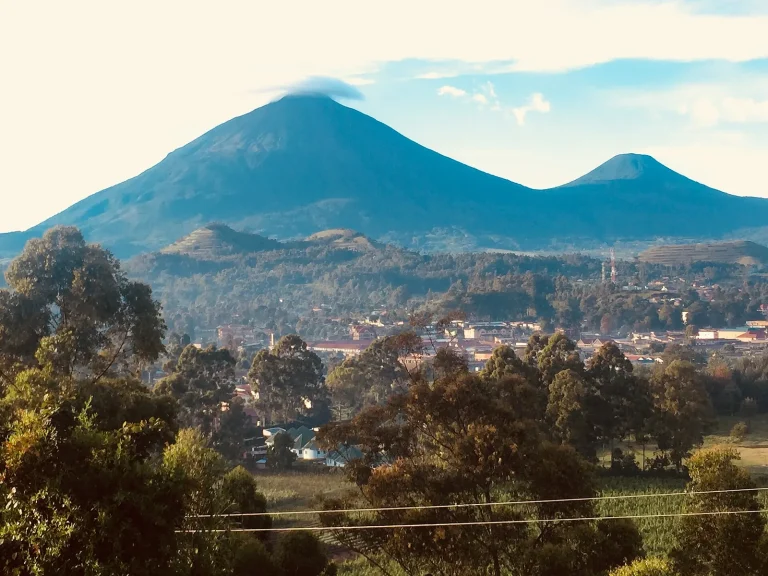
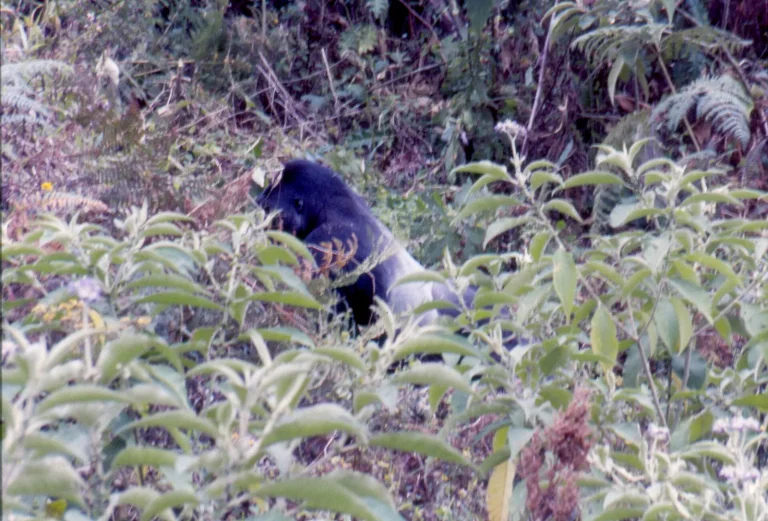
Mgahinga Gorilla National Park covers the Ugandan slopes of three Virunga volcanoes, right where Uganda meets Rwanda and the Democratic Republic of Congo. It is the smallest national park in Uganda, and it packs in one habituated gorilla family, golden monkeys, a Batwa cultural trail and some of the best volcano hikes in East Africa. This guide explains what to do here, how it differs from Bwindi, and how to plan a visit.
What Mgahinga is
Mgahinga sits in Kisoro District in the far south-west corner of Uganda and covers a little over 30 square kilometres. It was made a national park in 1991 and forms one part of a larger conservation area shared with Volcanoes National Park in Rwanda and Virunga National Park in Congo. The three parks are linked ecologically, and animals cross the borders freely even though visitors cannot.
The park rises from about 2,200 metres at its base to over 4,000 metres at the summit of Muhabura. That height creates several distinct habitats, from the farmland edge through montane forest and bamboo up to moorland and alpine vegetation near the peaks. Everything is cooler and wetter than in most of Uganda, so expect mist, cold mornings and views that appear and disappear within minutes.
The three volcanoes
- Muhabura is the highest, at over 4,000 metres, and has a crater lake near its summit. It is a demanding full-day climb.
- Gahinga is the lowest of the three at about 3,500 metres. Its crater is filled with swamp vegetation, and the climb is the shortest and gentlest.
- Sabinyo is the jagged, tooth-like volcano whose name means old man's teeth. It is the most adventurous hike, with ladders and steep ridge sections, and the summit is a point where Uganda, Rwanda and Congo meet.
All three are extinct or dormant. Together they give the park its unmistakable skyline and a set of hikes that reward fit walkers with views across three countries.
Gorilla trekking at Mgahinga
One habituated gorilla family lives in Mgahinga, and it is the only family you can visit here. Trekking works the same way as in Bwindi: a ranger briefing, a walk to find the family with trackers, a maximum of eight visitors and one hour with the gorillas at a distance of seven metres. The difference is that the terrain is more open, with bamboo and grassland alongside forest, and the walk can be shorter or longer depending on where the family has moved.
Because there is only one family, permits are scarce, and they sell out early in the dry seasons. The family also has a habit of wandering across the border into Rwanda or Congo for days or weeks at a time, so on some dates there are no gorillas to visit in Uganda. If this happens, permits can be moved or refunded under UWA rules, and we usually suggest a back-up trek in the Rushaga or Nkuringo sectors of Bwindi. Keep your dates flexible if Mgahinga is essential to you, and read our permit guide for how allocation works.
Golden monkey tracking
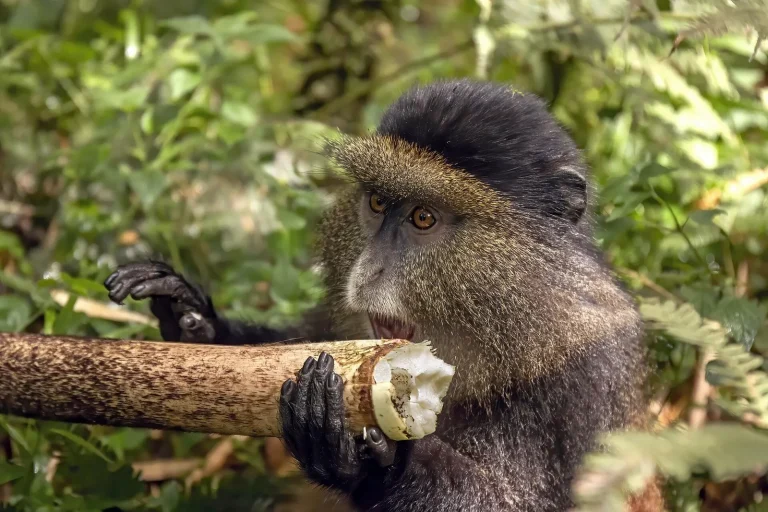
Golden monkeys are one of the reasons to come to Mgahinga even if you have already seen gorillas. They are an endangered subspecies that lives only in the bamboo forests of the Virunga volcanoes, with a golden-orange back and a black tail and limbs. Groups can number in the dozens, and they are active, noisy and fast, so tracking is lively rather than quiet. You spend an hour with them, and the constant movement makes them a joy to photograph. Read the full guide to golden monkey trekking.
The Batwa Trail
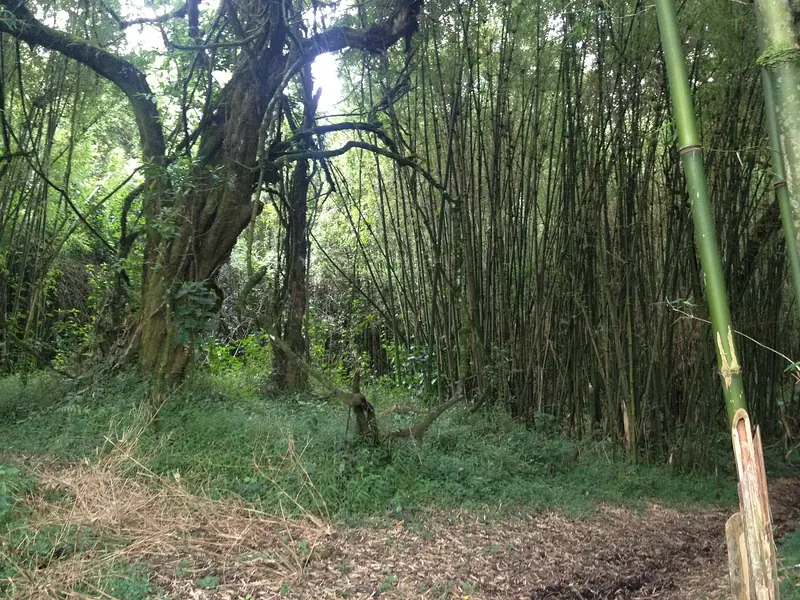
The Batwa lived in the forests of this region for generations before the parks were created, hunting and gathering and sheltering in caves. Today Batwa guides lead a cultural walk that shows how they used the forest for food, medicine and shelter, and it usually finishes at Garama Cave, a lava tube once used as a meeting place and refuge. The trail is a way to hear the forest's history from the people who know it best, and the income goes directly to Batwa communities. Ask us to book it in advance, because guides need notice. Read the full guide to the Batwa cultural experience.
Volcano hikes
| Hike | Effort | What to expect |
|---|---|---|
| Gahinga | Moderate | The shortest climb, through bamboo to a swampy crater. A good first volcano. |
| Sabinyo | Hard | A full day with steep ridges and ladders. The summit meets the borders of three countries. |
| Muhabura | Hard | The highest peak, a long climb with a crater lake at the top and cold, changeable weather. |
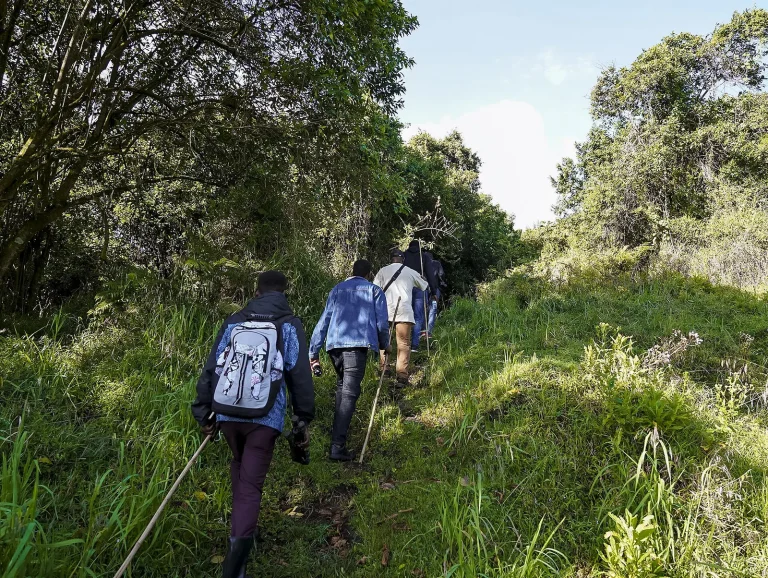
All volcano hikes need a guide, an early start, waterproofs, warm layers and good boots. Weather can change fast at altitude, and clear views are never guaranteed, so treat the summit as a bonus and enjoy the forest on the way up.
The Buffalo Wall and other short walks
If you want something gentler, the park has shorter guided walks, including the route along the Buffalo Wall, a low stone wall built along the boundary to keep buffalo and elephants out of the farmland below. The walk is easy and gives good views of the patchwork of fields against the volcano slopes. Birdwatchers can also expect a good list, including several Albertine Rift species, so bring binoculars.
Mgahinga or Bwindi?
| Mgahinga | Bwindi | |
|---|---|---|
| Gorilla families | One | Around twenty, across four sectors |
| Permit availability | Very limited | Much easier |
| Landscape | Volcanoes, bamboo, open slopes | Dense, steep rainforest |
| Other activities | Golden monkeys, Batwa Trail, volcano hikes | Birding, forest walks, Habituation Experience |
| Weather | Cooler and wetter | Mild, humid |
Most visitors do both. A common pattern is to trek in Rushaga or Nkuringo, which are within a couple of hours of Mgahinga, and then spend a day or two here for golden monkeys and a hike. Our destinations guide shows how the parks fit together.
Wildlife beyond the primates
Mgahinga is small, but the range of habitats gives it more wildlife than its size suggests. Forest buffalo, bushbuck and black-fronted duiker live in the forest and bamboo, elephants occasionally wander in from the surrounding landscape, and leopards and spotted hyenas are present but rarely seen. The bird list runs to roughly 180 species, including several that live only in the Albertine Rift, and the bamboo and moorland zones each have their own specialists. You will not see the volume of animals you would on a savannah safari, but a guided walk here is rarely dull.
Community and conservation
The land around Mgahinga is densely farmed, and the park's future depends on the people who live beside it. Visitor fees pay for rangers and trackers, and a share of park revenue goes to neighbouring communities. The Batwa Trail, craft cooperatives and village walks add further income, and choosing them directly supports families who once depended on the forest. If you want your visit to matter, book community activities and buy crafts from local groups instead of large shops.
A sample two-day plan
- Day one, gorillas and rest. Early briefing at the park headquarters, trek to the gorilla family and spend the hour, then return to your lodge for a long lunch. In the late afternoon, take an easy walk along the Buffalo Wall.
- Day two, golden monkeys and a hike. Track golden monkeys in the morning, then either climb Gahinga if you have energy or join the Batwa Trail in the afternoon. Finish at a lodge with a view of the volcanoes.
If the gorilla family has crossed the border, day one becomes the Batwa Trail and a short hike, and we rebook the gorilla trek in Rushaga. For longer trips that combine several parks, see our itineraries.
Getting there
- From Kisoro. The park gate is a short drive from Kisoro town, and most lodges will arrange transport.
- From Kigali. The road to Kisoro through the Cyanika border crossing takes about four to five hours, which makes Mgahinga the closest gorilla park to Rwanda's capital.
- From Kampala or Entebbe. By road it is nine to ten hours, so most travellers fly to Kisoro airstrip, which takes about an hour and a half.
- From Bwindi. Nkuringo and Rushaga are roughly one and a half to three hours away by road, depending on weather and road works.
When to go
The driest months, June to September and December to February, give the best conditions for hikes and views. The wetter months bring mud, mist and colder days, but also fewer visitors. Mgahinga is noticeably colder than Bwindi at any time of year, and it rains often. See our guide to the best time to go for a month-by-month breakdown.
What to bring
The kit list is the same as for Bwindi, with extra emphasis on warmth: a fleece, a hat and gloves, a proper waterproof jacket and boots with good grip. A walking pole helps on the volcano hikes. If you are combining hikes with gorilla trekking, bring gaiters and a spare set of dry socks.
Where to stay
Accommodation is concentrated around Kisoro, the shores of nearby lakes and the road to the park gate. Choose between simple guesthouses, midrange lodges with volcano views and a few higher-end properties. Book lodging and permits together, because rooms near the park are limited. See our lodges guide for how to choose.
Plan a Mgahinga trip
Tell us how many days you have and whether you want gorillas, golden monkeys or a volcano hike, and we will build a route around your permit.
Plan my trip