
The Batwa cultural experience is a half-day activity led by Batwa community members, built around the forest knowledge their families carried for generations before the national parks were created. It is offered near both Mgahinga and Bwindi, and it gives a very different kind of morning from a wildlife trek: one centred on people and history rather than animals.
This guide explains who the Batwa are, what the experience involves, and how it fits alongside gorilla trekking.
Who the Batwa are
The Batwa are an indigenous forest people of the Great Lakes region of Central Africa, traditionally living as hunter-gatherers in the forests that are now Bwindi, Mgahinga and the neighbouring Virunga parks in Rwanda and Congo. For generations, their knowledge of the forest, its plants, its animals and its seasons was passed down directly through daily life in the trees rather than written down.
When Bwindi and Mgahinga were gazetted as national parks in 1991, to protect the mountain gorillas and the forest itself, the Batwa living inside their boundaries were required to leave. Most received little or no land in return, and many settled in poverty on the edges of the parks they could no longer legally enter. This displacement is a well-documented part of the region's conservation history, and it is the honest context for any visit to a Batwa cultural site today: the parks that protect the gorillas were, for the Batwa, also a loss of home.
What the experience involves today
Tourism has become one of the few ways some Batwa communities can access an income connected to the forest they once called home, and the cultural experience is built around demonstrating skills that would otherwise have no living audience. A typical visit includes:
- Forest walks. Batwa guides lead you along trails, pointing out plants once used for food, medicine and building, and explaining how they were identified and prepared.
- Hunting and gathering demonstrations. Guides show traditional techniques such as fire-making by friction, arrow-making, and how honey was once gathered from wild hives high in the trees.
- Music, dance and storytelling. Most visits end with traditional songs and dances, and sometimes a chance to try local instruments, alongside stories about forest life before the parks existed.
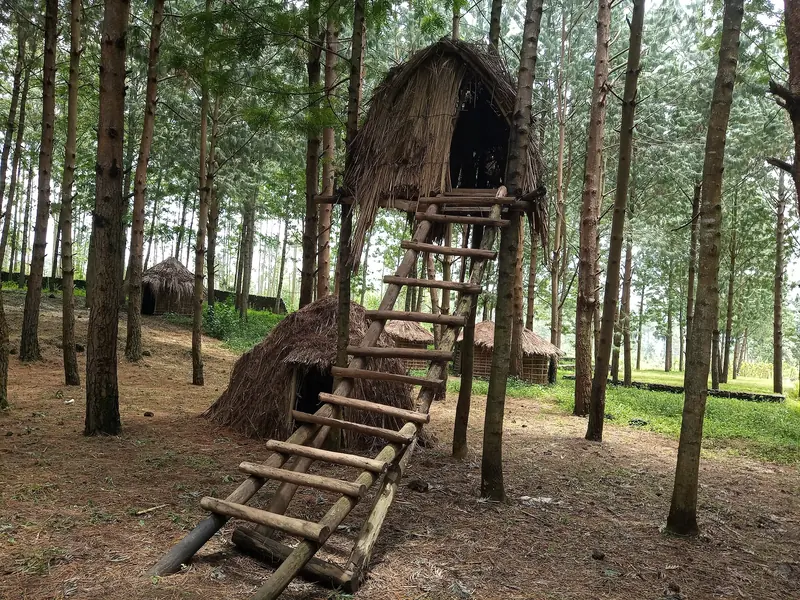
- A visit to a recreated dwelling or cave. Some sites include reconstructed traditional shelters or a visit to a cave once used for shelter and ceremonies, such as Garama Cave near Mgahinga.
Where it is offered
Near Mgahinga, the Batwa Trail is the best-known version of the experience, usually finishing at Garama Cave, a lava tube once used as a shelter and meeting place. Near Bwindi, similar experiences are offered by community groups close to several of the trekking sectors, often as a half-day add-on the afternoon after a gorilla trek. Ask us which option fits your route best, since availability and format vary by sector.
How tourism income reaches the community
Fees for the Batwa cultural experience go directly to the community groups and guides who run it, rather than to the park authority, which is different from how gorilla permit revenue is distributed. Buying crafts, baskets and woven items directly from Batwa artisans during the visit puts income straight into the hands of the people who made them. If supporting the community matters to you, ask your guide how the fees for your specific visit are shared, since arrangements differ between sites.
Visiting respectfully
- Ask before photographing individuals, and be mindful that this is a livelihood and a living history, not a re-enactment for its own sake.
- Approach the visit as an opportunity to listen, and ask questions if your guide invites them.
- Buy crafts directly from the artisans where possible, rather than from unrelated shops elsewhere.
- Understand that what you are seeing is a demonstration of skills from a way of life that was disrupted, not a description of how the Batwa live today, since most now live in settled communities outside the forest.
Traditional forest knowledge
Much of what guides demonstrate reflects a body of knowledge built over generations of living inside the forest rather than visiting it. Plants that treated fevers, wounds or stomach complaints were identified by sight and smell, and the seasonal fruiting of particular trees told hunters and gatherers where food would be plentiful at different times of year. Honey gathering, in particular, was a skilled and risky task, involving climbing tall trees using vines and wooden pegs and using smoke to calm wild bees before removing the comb by hand.
Bows, arrows and snares were made from forest materials using techniques passed down directly rather than written, and a good guide can explain not just how a tool was made but why it was shaped the way it was, based on what it needed to catch or cut. Hearing this explained by someone whose own grandparents lived this way gives the demonstration a weight that a museum display cannot match.
Choosing a responsible visit
Not every Batwa cultural site operates the same way, and the difference matters. Look for experiences that are genuinely run or co-run by Batwa community members rather than simply staffed by them for a fee set entirely by an outside operator, and ask how the money from your visit is distributed. A responsible operator will be able to tell you clearly, and will not present the visit as a chance to see how the Batwa "still live," since almost all now live in permanent settlements rather than the forest. We work with community-led sites for exactly this reason.
Beyond the tourist trail
Some organisations working with Batwa communities go further than a single cultural visit, running education and land access programmes intended to address the lasting effects of displacement rather than only presenting its history to visitors. If a longer engagement interests you, ask us about community projects near Bwindi and Mgahinga that welcome visits, donations or volunteering alongside a standard trip, separate from the half-day cultural experience most travellers add to their itinerary.
What to bring
Comfortable walking shoes are enough, since trails are gentle and well established, and there is no need for the heavier boots or gaiters a gorilla trek requires. Bring small-denomination cash for craft purchases and tips, a hat for sun protection on more open sections of trail, and a camera, though remember to ask permission before photographing anyone directly. Water is usually provided or available to buy at the site, but carrying your own is sensible on a warm day.
How to combine it with gorilla trekking
The Batwa cultural experience is almost always added to an existing gorilla or golden monkey trip rather than booked alone, since it needs only half a day and fits naturally into an afternoon. It appears in several of our itineraries, including the 4-day double gorilla trek from Kigali and the 4-day chimpanzee and gorilla trekking safari. See our Mgahinga guide and Bwindi guide for how it fits around trekking in each area.
Practical details
The experience typically runs two to three hours and does not require the fitness level of a gorilla trek, since walking is at a gentle pace on established trails. It suits all ages, including children and travellers who may not want to attempt a forest trek. Book it in advance through us so a guide is available on your dates, particularly if you are adding it to a tight itinerary.
Add a Batwa cultural experience
Tell us your itinerary and we will fit a visit in near Mgahinga or Bwindi, whichever suits your route.
Plan my trip