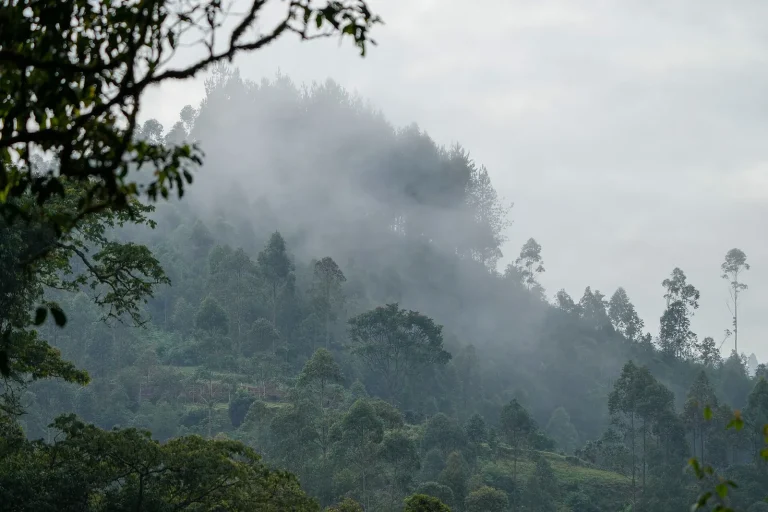
Bwindi Impenetrable Forest is one of the oldest and most biologically rich rainforests in Africa, and the single most important place on earth for mountain gorillas. It holds roughly half of the world's population, a UNESCO World Heritage listing since 1994, and four separate trekking sectors, each with its own character. This guide explains what makes Bwindi special, how the sectors differ, what else there is to do and how to choose where to stay.
What makes Bwindi special
Bwindi covers about 320 square kilometres of steep, folded hills in the south-west corner of Uganda, close to the borders with Rwanda and the Democratic Republic of Congo. Its altitude ranges from about 1,200 to more than 2,600 metres, and that variation creates an unusually rich mix of habitats, from lowland forest at the edges to montane forest and bamboo higher up.
The forest is thought to have survived through the last ice age when much of Africa's other forest disappeared, which is one reason it has such a rich variety of life. It supports more than 120 mammal species, over 350 bird species, hundreds of tree species and around 200 species of butterfly. It has ten primate species, including chimpanzees, black-and-white colobus, blue monkeys and L'Hoest's monkeys. It is also a stronghold for Albertine Rift endemic birds, species that live nowhere else, which is why serious birders often add it to a gorilla trip.
The name comes from the local word for the thick vegetation. Tree ferns, vines, moss and tall hardwood trees close in over the trails, and the forest floor is a tangle of undergrowth. It is dark, humid and constantly dripping, and it is easy to see why early explorers found it impenetrable.
How the forest became a park
Bwindi was first protected as a forest reserve in the 1930s. In 1991 it became a national park, and gorilla tourism began in 1993 with the opening of the first habituated group to visitors. UNESCO listed it as a World Heritage Site in 1994 in recognition of its biodiversity and its importance for the mountain gorilla. The park's story since has been one of balancing conservation with the needs of the people who live around it, especially the Batwa, who lived in and depended on the forest for generations before the park was created. Today, community programmes and cultural experiences aim to share tourism income with neighbouring villages and to give the Batwa a voice in how the forest is used.
The four trekking sectors
Trekking is organised through four sectors, each with its own park office, gorilla families and lodges. The sectors are far enough apart that choosing between them is an important decision. Moving from one to another can take half a day by road.
Buhoma (north)
Buhoma is the oldest sector and the one with the most developed tourism. The village sits at the forest's edge, with a wide choice of lodges from simple community camps to high-end properties, and a lively community feel. It is the easiest sector to combine with the Queen Elizabeth side of Uganda and is closest to Kihihi airstrip. Buhoma also has the best-known walking trails apart from gorilla trekking, including the waterfall trail and walks along the Munyaga River.
Ruhija (east)
Ruhija sits at a higher altitude, and the forest here is cooler, mistier and closer to bamboo and montane habitat. It is one of the best places in the country for birds, especially around the Mubwindi Swamp, where several rare Albertine Rift endemics can be found. Gorilla treks in Ruhija can be shorter or longer than average depending on where the family has moved. It suits birders and travellers who like a quieter, more remote setting.
Rushaga (south)
Rushaga has the largest number of habituated families and is the only sector that offers the Gorilla Habituation Experience. Its abundance of groups means permits are easier to find than in some other sectors, though the dry seasons still book out. It is about four to five hours from Kigali and closer to the Rwandan border than to Kampala, which makes it a natural base for travellers coming from Rwanda.
Nkuringo (south-west)
Nkuringo is known for dramatic scenery. The sector sits on a steep ridge with views across the valley to the Virunga volcanoes, and treks often involve descending steep slopes and climbing back out. It is challenging and rewarding, and many trekkers say the view from the lodge is as memorable as the gorillas. Recommended for fit walkers, and we suggest a porter and a walking pole.
| Sector | Character | Best for | Nearest airstrip |
|---|---|---|---|
| Buhoma | Developed, lively, many lodges | First-time visitors, combining with Queen Elizabeth | Kihihi |
| Ruhija | Higher, cooler, birdy | Birders, quieter stays | Kihihi |
| Rushaga | Most gorilla families, habituation | Flexible dates, Habituation Experience | Kisoro |
| Nkuringo | Steep, scenic, remote | Fit walkers, views | Kisoro |
Choosing a sector
A few rules of thumb help:
- If you have one trek and want simplicity, Buhoma or Rushaga are usually the easiest to plan.
- If you are combining with Rwanda, Rushaga is the closest to the border.
- If you want the Habituation Experience, you must stay in Rushaga.
- If you love birds, add Ruhija.
- If you want views and a challenge, choose Nkuringo.
- If you plan two treks, stay in one sector and choose two families there, or plan a half-day drive between sectors and treat it as a travel day.
Your permit decides your sector, so choose the sector before you buy anything else. Our permit guide explains how allocation works.
What to expect on a trek in Bwindi
Bwindi treks differ from those in the volcano parks. The forest is dense, and you often walk on narrow trails or off-trail, following trackers who clear a path through the undergrowth. Slopes can be steep and the ground slippery even in the dry season, so a walking pole and a porter make a real difference. The gorillas are often found in thick vegetation, which means views can be partial and photographs challenging. Patience, a fast lens and a willingness to crouch or move slowly are more useful than a long telephoto.
The walk itself is part of the experience. You will pass tree ferns, giant lobelia and orchids, hear forest birds and possibly see monkeys overhead. Rangers point out plants and animals along the way, and a slow, steady pace lets you enjoy them.
Other things to do in Bwindi
Gorillas are the headline, but the forest rewards those who stay a little longer.
- Forest walks and waterfall trails. Guided nature walks at Buhoma and Ruhija take you through the forest without the effort of a gorilla trek, with a chance of seeing monkeys, butterflies and unusual plants.
- Birdwatching. Bwindi is one of the best birding sites in Africa, with more than 350 species and many Albertine Rift endemics. Ruhija's Mubwindi Swamp and the trails around Buhoma are the classic locations.
- Batwa cultural experiences. Visits led by Batwa guides explain how the forest people hunted, gathered and lived before the park was created. They also show how tourism income supports Batwa communities.
- Community visits. Village walks, craft workshops and visits to local schools or health centres give a fuller picture of life around the forest and direct your money to local families.
- Chimpanzees, monkeys and forest elephants. Chimps live in Bwindi but are hard to see. For reliable chimp tracking, add Kibale on a longer trip, as suggested on our destinations page.
Getting to Bwindi
Bwindi is remote, and how you arrive shapes the trip.
- From Kampala or Entebbe by road, allow eight to ten hours. The route through Masaka, Mbarara and Kabale is scenic, and many people break the journey at Lake Mburo or Lake Bunyonyi.
- By air, scheduled and charter flights land at Kihihi for Buhoma and Ruhija, and at Kisoro for Rushaga, Nkuringo and Mgahinga. Flights take about an hour and a half and remove a long day of driving.
- From Kigali, the road to Rushaga takes roughly four to five hours through Kisoro. This suits itineraries combining Rwanda and Uganda.
- From Queen Elizabeth National Park, the Ishasha road leads to Buhoma in around two to three hours, which is the classic route on a longer safari.
Whichever route you choose, plan to arrive the afternoon before your trek so that a late vehicle or slow road does not put your permit at risk.
Where to stay
Each sector has accommodation ranging from budget camps to luxury lodges. Choose based on the sector where your permit is issued, not on how good the lodge looks in a photograph. A stay in the wrong sector can mean a drive of several hours before dawn. Popular lodges near the park offices fill quickly during the dry seasons, so we hold lodging and permits together. Browse options on our lodges page.
When to go
Bwindi can be visited all year, but the forest is wet in every season. The driest months are June to September and December to February, while March to May and October to November are wetter, with muddier trails and lower demand. Roads to Nkuringo and parts of Ruhija can be difficult after heavy rain. Our guide to the best time to go covers each month in detail.
How to visit responsibly
- Follow the rangers' instructions and the seven-metre rule.
- Do not trek if you are ill.
- Hire a porter and buy crafts from local cooperatives.
- Choose lodges that employ local staff and support community projects.
- Take your rubbish with you and stay on marked trails during walks.
To learn about the animals themselves, read our guide to mountain gorillas, and to see how a trek runs, start on our homepage guide to gorilla trekking in Uganda.
Choose a sector with us
Tell us your fitness level, dates and whether you want birds, views or the Habituation Experience. We match the sector to you.
Enquire