
Golden monkeys are one of Uganda's most photogenic primates, and Mgahinga Gorilla National Park is the only place in the country where you can track them. Set against the bamboo forest on the slopes of the Virunga volcanoes, a golden monkey trek is shorter and gentler than a gorilla trek, and it pairs naturally with one on the same trip.
This guide covers what golden monkeys are, how a trek works, and how to fit it around your gorilla permit.
What a golden monkey is
The golden monkey is a subspecies of the blue monkey, found only in the bamboo forests of the Virunga volcanoes, a range shared by Uganda, Rwanda and the Democratic Republic of Congo. It gets its name from the bright orange-gold fur across its back and flanks, which contrasts sharply with its black limbs, tail and cap. Adults are small, quick and highly social, living in troops that can number anywhere from a handful to more than sixty individuals.
Like the mountain gorilla, the golden monkey is found in very few places on earth and is considered endangered, which makes trekking to see them part of the same conservation story as gorilla tourism: visitor fees fund the rangers who protect the forest they depend on.
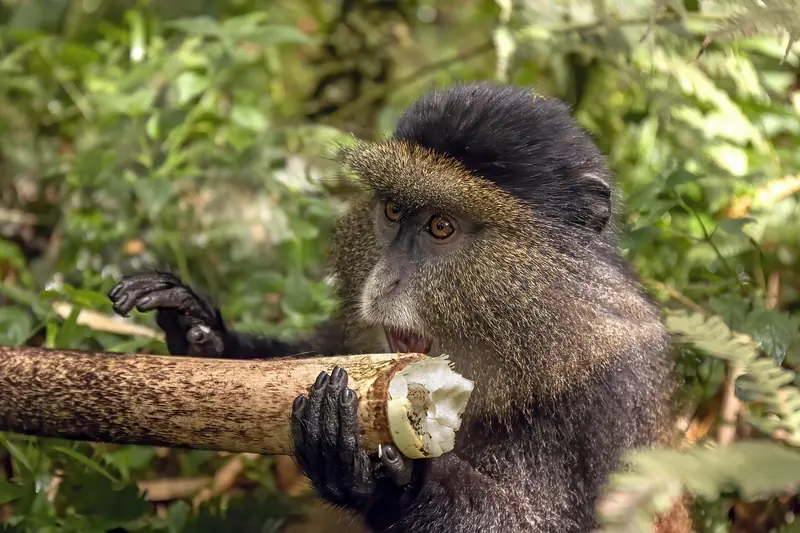
Where you can trek them
Mgahinga Gorilla National Park is the only site in Uganda offering golden monkey trekking. The habituated troop lives in the bamboo zone on the lower slopes of the volcanoes, an easier environment to move through than Bwindi's dense rainforest, which is part of why the trek itself is generally shorter and less demanding. Read more about the park in our Mgahinga guide.
What the trek involves
The pattern will be familiar if you have read about gorilla trekking: an early briefing at the park headquarters, then a walk with rangers into the bamboo forest to find the troop, which trackers will have already located that morning. Because golden monkeys move constantly and forage across a wide area, the walk can vary from under an hour to a couple of hours, generally shorter than a typical gorilla trek.
Once you find the troop, you spend one hour watching them. Unlike the calm, deliberate movement of gorillas, golden monkeys are almost constantly active, leaping between bamboo stems, chasing each other and stripping shoots to eat, which makes for lively, fast-moving photography rather than the slow observation of a gorilla encounter. The energy of the group is one of the main reasons visitors enjoy adding this trek to their trip.
Golden monkeys compared with gorillas
| Gorilla trekking | Golden monkey trekking | |
|---|---|---|
| Typical walk to find them | 1 to 6 hours | Under 1 to 2 hours |
| Time observing | 1 hour | 1 hour |
| Group size in the wild | 10 to 30 | Can exceed 60 |
| Pace of the encounter | Calm, slow-moving | Fast, constant activity |
| Physical demand | Moderate to high | Generally lower |
Many visitors describe the two treks as complementary rather than similar: gorillas reward patience, golden monkeys reward a quick eye and a fast shutter.
A day of golden monkey trekking
The morning starts much like a gorilla trek, with a briefing at the Mgahinga park headquarters where rangers explain the rules and assign you to a guide. From there you walk into the bamboo zone on the lower slopes of the volcanoes, generally an easier gradient than the steep, tangled trails of Bwindi. Trackers who went ahead at first light have usually already located the troop by the time you set out, which keeps the walk itself relatively short and predictable.
Finding the monkeys is often more about following sound than sight at first, since a large troop moving through bamboo makes a distinctive rustle and chatter well before you see them. Once you catch up, the hour passes quickly: monkeys leap between stems, strip bamboo shoots with practised hands, groom each other and chase off intruders, rarely staying in one spot for more than a few seconds. Guides are skilled at predicting where the group will move next, which helps you stay close without disturbing them.
Conservation status
Golden monkeys are classified as endangered, with a total population estimated at a few thousand individuals confined to the bamboo forests of the Virunga volcanoes, a much smaller range than most primates depend on. Habitat loss at the forest edge and the same regional instability that has affected gorilla conservation in the past are the main pressures on the species. As with gorillas, permit revenue funds the ranger patrols and habituation work that keep this troop safe, so a trek here supports the same conservation model that has helped mountain gorilla numbers recover.
Photography tips
Golden monkeys move fast, so a quick shutter speed matters more here than for gorilla photography, where subjects sit still for long stretches. A mid-range zoom lens in the region of 100 to 300 millimetres works well in the relatively open bamboo forest, and a higher ISO setting helps freeze motion in the shaded light beneath the canopy. Many photographers find that focusing on a single individual rather than trying to capture the whole troop gives better results, since the group's constant movement makes wide shots difficult to compose.
Permits and booking
Golden monkey trekking needs its own permit, separate from a gorilla permit, and it is considerably easier to obtain since demand is lower and the troop is large. We book it together with your gorilla permit when you are trekking both in the same trip, so your schedule and transport line up without unnecessary backtracking. See our permit guide for how gorilla permits work; golden monkey permits follow a similar principle but at a different tariff and with more flexibility on dates.
Best time to go
Golden monkey trekking is possible all year, since the troop stays within the bamboo zone rather than ranging as widely as gorillas can. The dry seasons, June to September and December to February, give firmer underfoot conditions, while the wetter months bring fewer visitors and a lush, misty forest. See our guide to the best time to go for how this compares with gorilla trekking seasons.
Combining it with gorilla trekking
Because both activities are based in or near Mgahinga, golden monkey trekking is one of the easiest add-ons to a gorilla trip. Many visitors trek gorillas one morning and golden monkeys the next, without changing lodges. It also appears in several of our set itineraries: see the 6-day double gorilla trek, which includes a golden monkey walk between two gorilla treks, or the 4-day double gorilla trek from Kigali for a faster version of the same route.
Health and behaviour rules
The same principle that protects gorillas applies here: golden monkeys can catch human respiratory illnesses, so do not trek if you are unwell. Keep a reasonable distance, avoid direct eye contact that a monkey might read as a challenge, and never offer food, since habituated animals that learn to expect it from visitors can become a problem for the rangers managing the troop long after your visit ends.
What to bring
The kit list mirrors gorilla trekking: waterproof boots, long trousers and sleeves, a rain jacket and insect repellent. Because the walk is often shorter and less strenuous, you can travel lighter, but bring a camera with a reasonably fast shutter speed if photography matters to you, since the monkeys rarely stay still for long. See our full packing guide.
Where to stay
Lodges near Mgahinga, mostly around Kisoro, serve both golden monkey and gorilla trekking, so no separate accommodation is needed if you are doing both. See our lodges guide for options in the area.
Add golden monkey trekking to your trip
Tell us your dates and we will check both permits together and build a route that fits them in without wasted travel.
Plan my trip