
Murchison Falls National Park is Uganda's largest protected area and the place where the Nile is squeezed through a gap only a few metres wide before dropping in a thunderous, permanently misted waterfall. It sits well north of the gorilla parks, which makes it a destination for longer trips rather than a quick add-on, but it rewards the extra distance with some of the biggest game numbers and the most dramatic single landmark in the country.
This guide covers the falls, the wildlife, the boat cruise, and how it fits into a longer Uganda itinerary.
Where the park sits
Murchison Falls lies in north-western Uganda, split by the Nile as it flows from Lake Victoria toward Lake Albert and on into South Sudan. It is roughly six to seven hours by road from Entebbe or Kampala, and considerably farther from the gorilla parks in the south-west, which is why it usually appears on trips of ten days or more, or as a separate safari in its own right rather than a stop bolted onto a gorilla trip.
The falls themselves
The Nile, more than fifty metres wide upstream, is forced through a gap in the rock only a few metres across at Murchison Falls, and the resulting torrent drops around 43 metres in a permanent cloud of spray, often crossed by a rainbow in the afternoon light. It is one of the most powerful single stretches of the river anywhere along its course, and both a viewpoint above the falls and a boat trip to their base give very different, equally memorable views of the same spot.
The boat cruise
A boat trip on the Nile below the falls is the park's signature activity. Cruises head upstream from the jetty toward the base of the falls, passing large pods of hippos, Nile crocodiles basking on the banks, and elephants and buffalo that come down to drink. Birdlife along this stretch is outstanding, and the elusive shoebill stork is seen here more reliably than almost anywhere else in Uganda. The cruise typically runs for two to three hours and needs no separate permit beyond the ticket.
Game drives
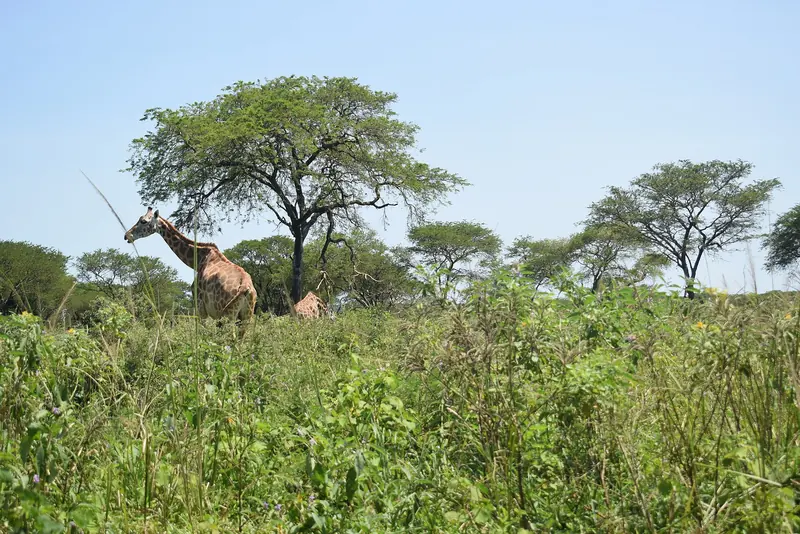
The savannah north of the Nile holds the bulk of the park's big game: large herds of Rothschild's giraffe, elephant, buffalo and Uganda kob, along with lion and the occasional leopard. Game drives here cover wide, open country very different from the forest tracking of the gorilla and chimpanzee parks, and early morning and late afternoon drives give the best activity as animals move in the cooler hours.
Other activities
- Top of the falls walk. A short trail leads to a viewpoint directly above the drop, close enough to feel the spray and hear the full force of the water.
- Budongo Forest. On the park's southern edge, Budongo offers chimpanzee tracking as an alternative or addition to Kibale, along with strong forest birding.
- Sport fishing. The Nile below the falls is known for Nile perch, and catch-and-release fishing trips can be arranged through several lodges.
History and the name
The falls were named in 1864 by the explorer Samuel Baker, one of the first Europeans to see them, after the then-president of the Royal Geographical Society. The park itself was gazetted in 1952 and has had a difficult history since, including a period in the 1970s and 1980s when instability and poaching sharply reduced its wildlife. Numbers have recovered substantially over the past two decades, and the park today is considered one of the clearest conservation recovery stories in the country, a useful piece of context for the scale of wildlife you now see on a game drive.
Ziwa Rhino Sanctuary on the way
Uganda's rhinos were wiped out by the late 1980s, and today the only place to see them in the wild in the country is Ziwa Rhino Sanctuary, roughly halfway along the road from Kampala to Murchison Falls. A guided walking safari here brings you on foot, with an armed ranger, to within a safe distance of southern white rhinos as part of a long-term programme to breed and eventually reintroduce them to the park itself. It is a natural stop to break the long drive north and a rare chance to see rhino on foot rather than from a vehicle.
More wildlife notes
Beyond the giraffe, elephant and buffalo of the northern plains, Murchison Falls holds good numbers of Jackson's hartebeest and oribi, and the park's varied habitat, from riverine forest to open savannah, gives it one of the longest bird lists of any Ugandan park, with well over 450 species recorded. Patas monkeys, the fastest primate in the world, are found on the northern plains, and the riverbanks below the falls hold some of the largest Nile crocodiles you are likely to see anywhere in East Africa.
Chimpanzee tracking in Budongo Forest
Budongo, on the park's southern approach, is one of the largest natural mahogany forests in East Africa and holds several habituated chimpanzee communities. Tracking here works the same way as in Kibale, with a briefing followed by a guided walk, and it makes a practical addition if your route to Murchison Falls already passes through the forest rather than requiring a special detour. Budongo is also known for its butterflies and forest birds, and its research station has studied the resident chimpanzees for decades.
The delta and the shoebill
Where the Nile widens into papyrus swamp before reaching Lake Albert, the Victoria Nile Delta is one of the most reliable places in Uganda to see the shoebill, a huge, prehistoric-looking stork that many birders travel specifically to find. A dedicated delta boat trip, longer and quieter than the standard falls cruise, gives the best chance, moving slowly through the channels where the birds stand motionless waiting for lungfish. The delta also holds good numbers of waders and herons, and the change of scenery from open river to swamp is striking in its own right.
How it fits a longer trip
Because of the distance involved, Murchison Falls is best suited to itineraries of ten days or more that already include gorillas, chimpanzees and a southern safari, or to a standalone Uganda safari built around the park itself. It pairs naturally with Kibale on a longer northbound route, or can be flown into directly from Entebbe to shorten the travel time. See our destinations guide for how it fits alongside the parks in the south-west, and talk to us about adding it to a custom route on our trip planner.
When to go
The dry seasons, June to September and December to February, give firmer roads and the best game viewing, as animals gather along the river and grass is shorter. The wetter months bring lush scenery and fewer visitors, though some park roads can be slower after heavy rain. See our guide to the best time to go for how this compares with the trekking parks further south.
Health and what to bring
Murchison Falls sits at a lower altitude than the gorilla parks and is noticeably hotter, particularly on the open savannah north of the river, so light, breathable clothing works better here than the layers needed in Bwindi. Sun protection matters more on game drives than on forest treks, given the long hours in an open vehicle, and standard malaria precautions apply across the park. A dust cover for cameras and bags is worth having on dry-season game drives.
Early morning game drives also avoid the worst of the midday heat for both you and the animals, which are far more active in the cool hours around sunrise than during the middle of the day.
Getting there
Most visitors reach Murchison Falls by road from Kampala or Entebbe, a drive of six to seven hours often broken with a stop at the Ziwa Rhino Sanctuary along the way. Scheduled and charter flights also connect Entebbe to airstrips within the park, cutting the journey to under an hour and a half, a popular option for travellers short on time.
Sample two-night plan
- Day one, arrival and Ziwa. Drive from Kampala with a stop at Ziwa Rhino Sanctuary for a walking safari, then continue to the park for the evening.
- Day two, falls and game drive. Morning game drive on the northern plains, afternoon boat cruise to the base of the falls.
- Day three, departure or extension. A final short game drive or the delta boat trip for the shoebill, then the drive or flight back.
Where to stay
Lodges are found on both the northern and southern banks of the Nile, ranging from tented camps to more comfortable lodges with views over the river. See our lodges guide for how we choose accommodation across a longer Uganda itinerary.
Add Murchison Falls to your trip
Tell us how many days you have, and we will tell you honestly whether it fits or whether it is better as a separate trip.
Plan my trip