
Kibale National Park is Uganda's chimpanzee capital, and along with Bwindi it forms the second half of the country's two flagship primate experiences. Its forest holds one of the highest densities of primates anywhere in Africa, with over a thousand chimpanzees living within the park.
This guide covers chimpanzee trekking, the other primates and activities in Kibale, and how to combine it with a gorilla trip.
Where Kibale sits
Kibale lies near Fort Portal in western Uganda, roughly three hours north of Queen Elizabeth National Park and six to seven hours by road from Entebbe or Kampala. It sits within a landscape of tea plantations and rolling farmland, which makes the sudden wall of rainforest at the park boundary a striking contrast. The park connects southward to Queen Elizabeth through a wildlife corridor, which is part of why the two are so often visited together.
Chimpanzee trekking
Chimpanzee tracking in Kibale works on the same basic pattern as gorilla trekking: an early briefing at the park headquarters, then a guided walk with rangers into the forest to find a habituated community. The differences are in the animals themselves. Chimpanzees are far more active than gorillas, moving quickly through the canopy and calling loudly to other groups, so a trek is often a matter of keeping pace rather than sitting quietly. Sightings usually take one to three hours to arrange, and once found you spend up to an hour observing them, watching feeding, grooming and the social drama that chimpanzee groups are known for.
Permits are required and are separate from gorilla permits, priced and issued independently by the Uganda Wildlife Authority. They are easier to obtain than gorilla permits because more communities are open to visitors and demand is lower, but booking ahead is still worthwhile in peak season.
The Chimpanzee Habituation Experience
For a longer encounter, Kibale offers its own habituation experience, joining researchers who follow a community still being introduced to human presence. It runs from early morning until the chimpanzees settle for the night, giving several hours with the group rather than one, and a close look at the daily work of habituating a wild primate population. Numbers are limited and it should be booked well in advance.
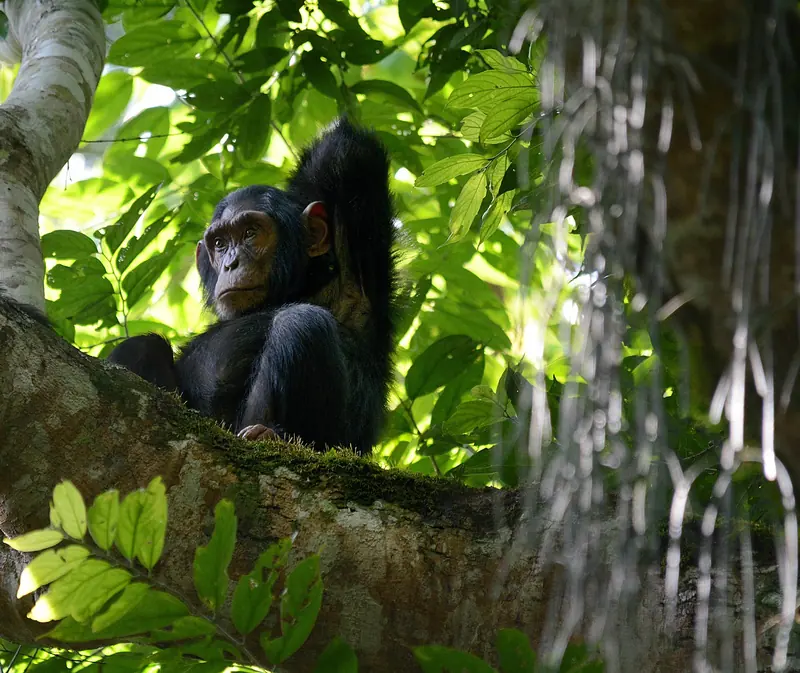
A day of chimpanzee trekking
The day begins early, with a briefing at Kanyanchu, the main trailhead, around 6:00 or 8:00 depending on which session you book. Rangers explain the rules, similar to gorilla trekking: keep a distance, keep your voice down, and follow instructions if the group's mood shifts. Trackers who went ahead at dawn radio back the community's location, and your guide leads the group in from there, often moving quickly to keep pace with animals that rarely sit still for long.
Once you catch up with the chimpanzees, you spend up to an hour with them, watching them feed high in fig trees, groom each other on the forest floor, or move as a loose troop between feeding sites. Calls between different chimpanzee groups often echo through the forest, a sound many visitors find as memorable as the sighting itself. The walk back typically takes less time than the walk in, and most treks are finished by late morning.
History of the park
Kibale was gazetted as a forest reserve in the early twentieth century, valued initially for timber, and became a national park in 1993 specifically to protect its exceptional primate populations. Long-term chimpanzee research has run in the park since the 1980s, and the communities open to visitors today are the same ones scientists have followed for decades, which is part of why so much is known about their individual personalities and family histories.
Getting there
- From Queen Elizabeth National Park. About three hours by road, the standard link on a combined itinerary.
- From Kampala or Entebbe. Roughly six to seven hours by road, or a domestic flight to Fort Portal or a nearby airstrip cuts this significantly.
- From Bwindi. A full day's drive on its own, which is why Kibale is usually reached via Queen Elizabeth rather than directly.
Other primates and wildlife
Kibale's primate list runs to thirteen species, more than any other Ugandan park. Alongside chimpanzees, you are likely to see red colobus, black-and-white colobus, grey-cheeked mangabeys, red-tailed monkeys and L'Hoest's monkeys, often several species in a single walk. The forest also holds forest elephants and buffalo, though they are seen far less often than the primates, and the bird list includes hornbills, turacos and a range of forest specialists that draw dedicated birders.
Bigodi Wetland Sanctuary
Just outside the park, the community-run Bigodi Wetland Sanctuary offers an easier, cheaper walk through papyrus swamp and forest edge, with a good chance of monkeys, over 200 recorded bird species, and the striking great blue turaco. It is a popular half-day add-on for travellers who want a gentler activity alongside a chimpanzee trek, and the fees support the local community that manages the trail.
Kibale compared with gorilla trekking
| Gorilla trekking (Bwindi) | Chimpanzee trekking (Kibale) | |
|---|---|---|
| Minimum age | 15 | 12 |
| Time with the animals | 1 hour | 1 hour (up to a full day on the Habituation Experience) |
| Group size | Up to 8 | Up to 6 |
| Pace | Slow, quiet observation | Faster, following an active group |
| Permit cost | Higher | Lower |
Many first-time visitors assume the two experiences will feel similar because both involve tracking a great ape through forest, but the temperament of the animals makes them genuinely different days. Gorillas reward patience and stillness; chimpanzees reward a willingness to move quickly and adapt to where the group goes next.
Nature walks and night walks
Beyond chimpanzee tracking, Kibale offers guided day walks and night walks through the forest on trails separate from the main tracking routes. Day walks focus on the forest's other primates, plants used in traditional medicine, and the sheer density of birdlife, while night walks give a chance of seeing nocturnal species such as bushbabies, civets and, occasionally, the elusive potto, none of which appear on a standard chimpanzee trek. These walks are shorter and less physically demanding, and they make a good addition for travellers staying two nights rather than passing through in one.
How to combine it with gorilla trekking
Kibale sits north of Queen Elizabeth, so a common route treks gorillas in Bwindi, crosses Queen Elizabeth for a safari, and finishes with chimpanzees in Kibale before heading back to Entebbe. See our 4-day chimpanzee and gorilla trekking safari for a shorter route that links Kibale straight to Bwindi through Ishasha, or the 6-day gorilla and wildlife safari to add full Queen Elizabeth game drives as well. Our destinations guide shows how the parks in this region connect.
When to go
Chimpanzee sightings are reliable throughout the year, because trackers locate a community before visitors set out, much as with gorillas. The dry seasons, June to September and December to February, make the forest floor easier underfoot, while the wetter months are quieter and the forest is at its most lush. See our guide to the best time to go for a fuller comparison.
What to bring
The kit list is close to what you need for gorilla trekking: waterproof boots, long trousers and sleeves, a rain jacket and insect repellent. Chimpanzee treks can move faster over more open ground, so lighter, more breathable layers are often welcome. See our full packing guide.
Health and what to bring
Kibale sits at a lower, warmer altitude than the gorilla parks, so the forest is humid rather than cold, and a lighter rain jacket often suffices where Bwindi calls for a heavier one. Waterproof boots and gaiters are still worth packing, since trails can be muddy year round, and a strong insect repellent matters more here than in the cooler forests further south. As with any forest trek, avoid tracking if you are unwell, since chimpanzees are vulnerable to human respiratory illnesses in the same way gorillas are.
Booking your permit
Chimpanzee permits are booked through the Uganda Wildlife Authority, either directly or through us as part of a wider itinerary, and morning sessions are the first to sell out in peak months. We check availability alongside any gorilla permits on the same trip, so the two bookings line up with a sensible route between the parks rather than forcing an awkward detour.
Confirm your permit at least a few weeks ahead for the dry season, and a little less in the quieter wetter months when demand is lower across the board.
Where to stay
Accommodation near Kibale ranges from simple forest camps to well-appointed lodges, several set right against the park boundary with the forest calls audible after dark. See our lodges guide for how we choose where you stay.
Add chimpanzee trekking to your trip
Tell us your dates and we will check chimpanzee and gorilla permits together and build the route between them.
Plan my trip